ACCOLADES: ACCOLADES:
Won a Guldbagge for Best Cinematography by Peter Mokrosinski
PRODUCTION NOTES:
Friends is based on a 1967 play written by Japanese novelist, dramatist and
photographer Kôbô Abé. The major themes of his work are the alienation of the
individual, the loss of identity, and the absurdity of human existence, which has
engendered comparisons to Kafka, Beckett and Harold Pinter. In Friends, though
the members of the family who invade this apartment claim to be devoting themselves to
social good, their actions are cruelly destructive. This collaboration between Japan and
Sweden was wrought with production problems. In the end the Japanese producer had
first-time director Kjell-Ake Andersson write the film's script. It was filmed in 1988 in
both Stockholm and in Calgary, Canada.

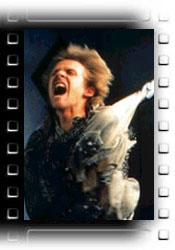
Scene from "Friends"
|
DETAILED DESCRIPTION OF FILM:
This is an absurdist play about strangers taking over a person's house and home. At
night in the city, a family of eight emerges from nowhere. It comprises the 80-year-old
grandmother, the gentlemanly-looking father, the mother, the eldest son who used to be a
private detective, the second son who used to be an amateur actor, the spinsterly eldest
daughter, the pure and attractive second daughter, and the impish youngest daughter. Their
mission is to find lonely residents in the city and offer friendship.
One night, this family visits a man in his apartment unit and finds an excuse to enter his
rooms. The man angrily accuses them of illegal entry and calls the police. The two
policemen who arrive and the landlord write him off as deluded and leave. The family
members prepare dinner, start fights, and gradually take over the household. The man
suddenly realizes that the eldest brother has stolen his wallet, but the father
rationalizes his son's actions as a means of managing the man's wealth. The family members
continue their barrage of rationalization in every way possible; the man finally gives in
and offers them his money and belongings in exchange for their departure.
Singing the "Broken Necklace" song, the family emphasizes the happiness of
togetherness. However, the man persists in his desire to be alone. Furthermore, the man
turns out to have a fiancée. She is becoming suspicious of the changes in him and visits
his home to question him. But the family members get around her, too. Persuaded by the
eldest daughter, the man gives up trying to drive out the family and tries to escape
instead. His attempt is discovered and he is shut up in a cage. Locked up, the man
gradually loses interest in the outer world of work and in his fiancée. When he is about
to get hold of the key to the cage from the second daughter, he dies from a moment of
excessive joy. Saying, "If he had only not been so defiant, we would only have been
good neighbors to him," the second daughter laments his death. The family members
gather together, march out of the apartment, and disappear into thin air. |

 Kjell-Åke
Andersson
Kjell-Åke
Andersson